
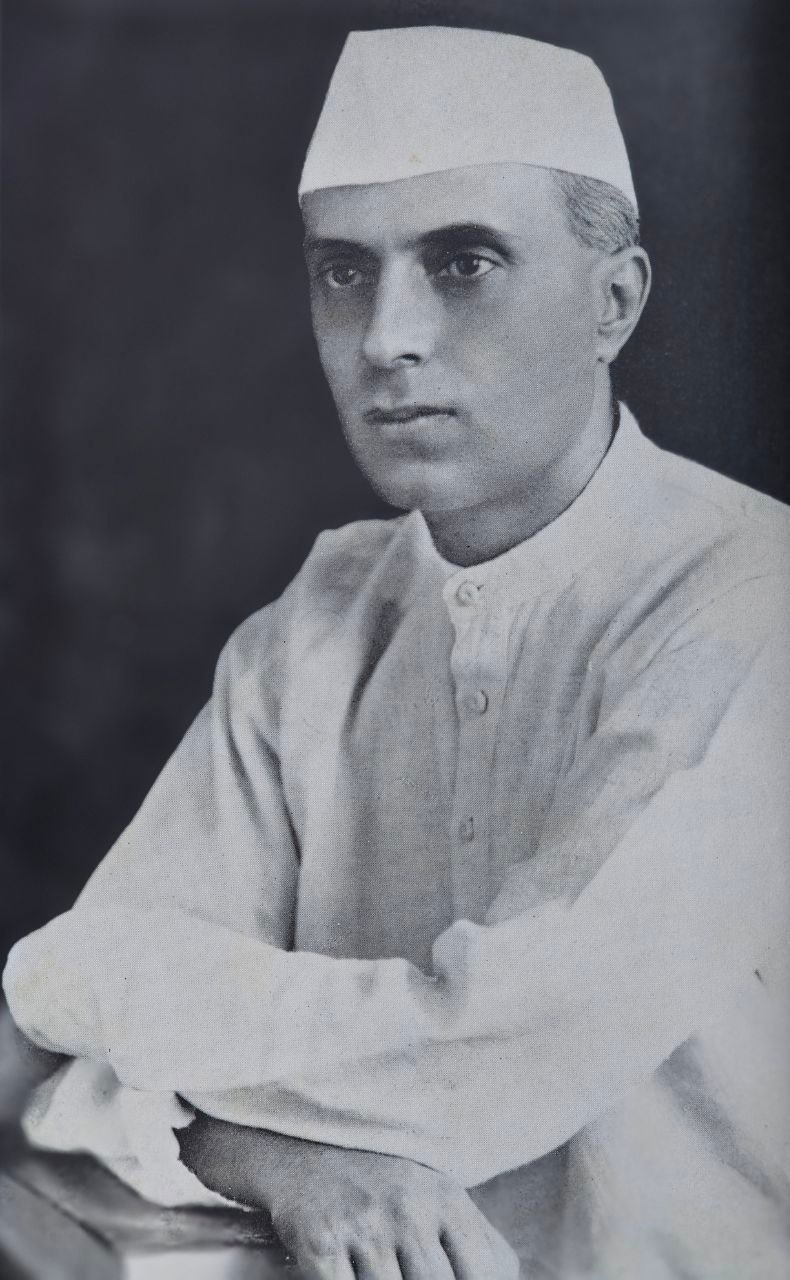
The Young Nehru and the Fear of the Unknown
Remembering Nehru’s First Arrest
Before Jawaharlal Nehru became a towering figure of independent India, he was also a young political worker learning, with nervous excitement and gradual endurance, what imprisonment under colonial rule actually meant. This small piece revisits Nehru’s first arrest on 6 December 1921, when the young barrister from Allahabad had already been appointed Secretary of the United Provinces Congress and was immersed in the ordinary, day-to-day work of the national movement.
In the winter of 1921, Nehru was sitting late in his Allahabad Congress office, “trying to clear up arrears of work,” when an excited clerk rushed in to inform him that the police had arrived with a search warrant and had surrounded the Congress office building.
Recalling the moment years later, Nehru wrote: “I was, of course, a little excited also, for it was my first experience of this kind, but the desire to show off was strong, the wish to appear perfectly cool and collected, unaffected by the comings and goings of the police.” He asked a clerk to accompany the police officer during the search and insisted that the office staff continue their work and ignore the police presence. Soon afterwards, a colleague who had been arrested outside the office was brought in by a policeman to bid him goodbye. “Full of the conceit that I must treat these novel occurrences as everyday happenings,” Nehru casually asked him and the policeman to wait until he had finished writing his letter. Soon came news of more arrests across the city. Returning home, he found the police searching Anand Bhavan and learnt that they had come “to arrest both father and me.”
The arrests were followed by what Nehru would later describe as “a farcical trial.” The charges themselves arose from the atmosphere of the Non-Cooperation movement, where Congress volunteer activities and even the circulation of hartal notices had begun to attract prosecution. But what remained with Nehru was the strange theatre of colonial legality surrounding the proceedings.
Recalling the court proceedings years later, Nehru wrote about one prosecution witness, who admitted that he had signed a police statement without reading it. Then “a tattered gentleman was produced who swore to my father’s signature. The man was quite illiterate and he held the signature upside down when he examined it.” As Nehru noted with characteristic simplicity, “My offence was distributing notices for hartal. This was no offence under the law then.” Yet, despite this, he wrote, “I was sentenced to six months’ imprisonment.”
Nehru’s recollection of entering prison for the first time is striking not because it is dramatic, but because of how honestly he captures the uncertainty surrounding imprisonment in those years. “Prison was still an unknown place,” he wrote. “Very few knew what happened behind the grim gates that swallowed the new convict.” Political imprisonment had not yet acquired the familiarity it later would during the national movement, and Nehru recalled that there was “the fear of the unknown and the unusual.” Yet there was also a strange excitement surrounding arrest and imprisonment, “a queer mixture of fear and adventure.” Looking back, Nehru wrote:
“Thousands of these have gone in and out many a time. They have got to know well what to expect inside. They have tried to adapt themselves to the strange life there, as far as one can adapt oneself to an existence full of abnormality and a dull suffering and a dreadful monotony. We grow accustomed to it, as one grows accustomed to almost anything. And yet, every time that we enter those gates again, there is a bit of the old excitement, a feeling of tension, a quickening of the pulse, and the eyes turn back involuntarily to take a last good look outside at the greenery and wide spaces, at people and conveyances moving about, at familiar faces that they may not see again for a long time.”
As the weeks in prison passed, Nehru wrote that “restrictions on us gradually grew in number.” Small liberties were withdrawn one after another and prison life settled into an exhausting routine. Yet what comes through in his writing is not bitterness alone, but the slow realization of how imprisonment altered one’s sense of time itself. “The days lengthened themselves into weeks,” he recalled, and the uncertainty of release became part of the punishment.
Yet Nehru was also conscious that imprisonment imposed burdens beyond the prison walls. “The real burden fell on our womenfolk,” he wrote, who had to endure “long periods of anxiety and suspense.” While political prisoners gradually adapted themselves to prison routine, families outside lived with uncertainty, waiting for letters, court dates and release orders. The imprisonment of nationalist workers was never borne by the prisoners alone. But in the world outside, “the real burden fell on our women-folk, our mothers and wives and sisters.” Nehru wrote that “they wearied with the long waiting, and their very freedom seemed a reproach to them when their loved ones were behind prison bars.”
Outside the prison walls, political events continued, movements rose and shifted, families waited anxiously, while inside there remained “the same dull routine,” the same monotony stretching endlessly forward.
Excerpts taken from Nehru: The First Sixty Years, selected and edited with introductory, historical, and other interpretative commentary by Dorothy Norman, with a foreword by Jawaharlal Nehru, Volume I, Asia Publishing House, 1965.
Kalyan Kumar
Advocate practising at the Bombay High Court, Nagpur Bench, and District Courts in Chandrapur.