Did Bakhtiyar Khalji Destroy Nalanda University?
A History of Many Interpretations
Did Bakhtiyar Khalji destroy Nalanda University? The answer may appear simple, but history is often more complicated than public memory. Historians frequently distinguish between three things: the event itself, how later people wrote about it, and how later generations remembered it.
In trying to understand the past, we often look at it through the lens of the present. Our ideas, beliefs, emotions, and political surroundings influence the way we interpret history. While thinking about the past, people often unknowingly carry present-day ideas and emotions into history. Two important examples of such historical reconstruction can be seen in the narratives surrounding the destruction of Nalanda University and the destruction of the Somnath temple.
Historian Romila Thapar, particularly in her work Somanatha: The Many Voices of a History, explains that history can often be understood through three connected layers: the event itself, how later people wrote about and interpreted the event, and the memory that later developed around it. The destruction of Nalanda can also be analysed through this framework. The military assault associated with Bakhtiyar Khalji forms the event; later Persian, Tibetan, colonial, nationalist, Marxist, and communal interpretations form the historiography; and the modern symbolic use of Nalanda as a metaphor for civilisational loss forms reconstructed memory. In this sense, Nalanda, like Somnath, is not remembered in the same way by everyone. Different groups and different time periods have given it different meanings. The story of Nalanda is important not only because of what may have happened there, but also because of how different generations have interpreted and remembered it.
The Event: What Happened at Nalanda?
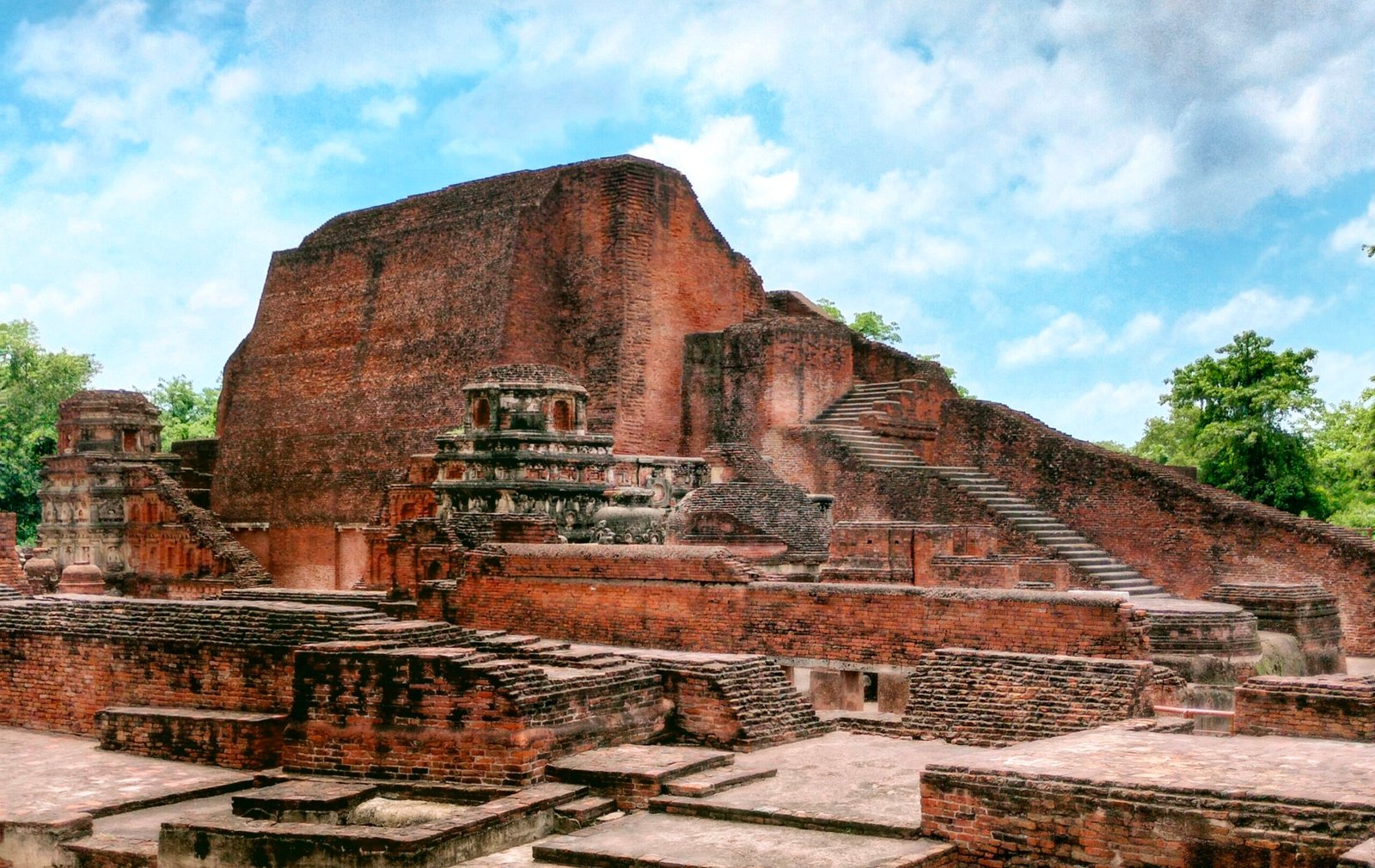
The first layer is the event itself — “what actually happened?” In the case of Nalanda, the destruction of the university is accepted by most historians as a historical fact, although the exact details and extent remain debated. At this level, historians ask simple but important questions: What happened? Who was involved? When did it happen? What evidence exists? Most historians agree that the military campaigns of Bakhtiyar Khalji in Bihar during the late 12th and early 13th centuries caused serious damage to important Buddhist centres such as Nalanda and Vikramashila. However, the historical evidence is not as direct or clear as it is often presented today.
The main Persian chronicle of the period, written by Minhaj-i-Siraj in the Tabaqat-i-Nasiri, describes the destruction of a major centre of learning in Bihar but does not clearly mention Nalanda by name. Later historians connected this account to Nalanda through archaeology and Buddhist records. Tibetan accounts from the same period suggest that Nalanda was badly damaged and largely abandoned, but not completely destroyed at once, as some teaching activity continued there for some time. Archaeological evidence also points towards fires, destruction, rebuilding, and gradual decline, but archaeology alone cannot always identify the exact perpetrators or their motives. This shows that even understanding what exactly happened is not always simple in history.
How Historians Interpreted Nalanda
The second layer is historiography (the later writings and interpretations around the event) — “how people later wrote about the event.” Over time, different historians, writers, governments, and communities interpreted the destruction of Nalanda in very different ways depending on the political and intellectual climate of their period. During the colonial era, many British historians described medieval India mainly as a long conflict between Hindus and Muslims. In this narrative, Bakhtiyar Khalji was portrayed as a symbol of Muslim barbarism, while Nalanda became a symbol of a lost Hindu-Buddhist golden age. Such interpretations also helped colonial rulers argue that India was too divided to govern itself.
Later, nationalist historians viewed Nalanda as proof of India’s ancient intellectual greatness and as evidence of a major civilisational rupture caused by invasions. In this telling, the destruction of Nalanda became more than a historical event; it became a symbol of the destruction of Indian knowledge itself. On the other hand, Marxist and social historians such as D. N. Jha and Richard Eaton argued for a more complex understanding. They pointed out that many Buddhist institutions were already weakening because of declining royal patronage, political instability, and economic difficulties, and that medieval military attacks were often linked more to political conquest and struggles for control than to religion alone.
Nalanda in Public Memory
The third layer is memory and reconstruction — “how later generations emotionally remember and use the event.” After many years, historical events often become symbols. People begin using them to express identity, pride, anger, nationalism, religion, or political mobilisation. Over time, people do not just remember such events; they attach emotions, identity, and politics to them. Over time, the destruction of Nalanda came to be remembered in very different ways by different groups. For some, it became a symbol of the destruction of India’s ancient knowledge traditions and a reminder of civilisational loss caused by invasions. Others interpret Nalanda through a more complex historical lens, arguing that its decline was gradual and shaped by political instability, weakening patronage, and multiple social factors rather than a single event alone. At the same time, for many Buddhists across Asia, Nalanda remains a sacred centre of Buddhist learning and a symbol of the rich intellectual and cultural heritage of Buddhism that once connected India with the wider Asian world.
Religion, Power, and Historical Complexity
The question then arises: can the destruction of Nalanda or Somnath be understood simply as acts carried out in the name of Islam as a religion? History becomes more complicated when religion is seen not only as faith, but also as something rulers have sometimes used to gain power and control. Across different periods of world history, many religions—not only Islam—have at times been invoked by rulers and empires to justify expansion, control, or destruction. This does not mean that violence defines a religion itself; rather, it shows how political authority has frequently used religious identity to legitimise power. Therefore, reducing events like Nalanda or Somnath to a single religious explanation risks oversimplifying a much larger historical process involving politics, military conquest, economics, and struggles for authority.
In this sense, the debate surrounding Nalanda is not merely about what happened in the 12th century. It is also about how societies remember the past, how political contexts shape historical interpretation, and how every generation reshapes the meaning of the past in its own way.
Kalyan Kumar
Advocate at the Bombay High Court, Nagpur Bench, and Chandrapur District Court.