Proper Perspective
Sitting on a wooden stool outside the roadside shop, I sip a cold drink and watch overloaded trucks go by. This is Mul, a nondescript taluka in central India which has the look of a small rural town struggling to catch up with urbanity. The afternoon is getting hotter by the moment and I wipe my face with lemon-scented moist wipes. Viju, my contact person, finally arrives and offers a bunch of excuses. He parks his motorcycle and buys several bottles of chilled Bisleri. The white car I have hired for the trip has already turned a dusty beige. The driver helps Viju load the bottles in the backs of seat covers and we manage to set off. I know Viju from my previous trips and by now I have a fair idea of the area too. This time we are going to a village which, he informs, is ‘just nearby’. We drive on a narrow, tarred road pockmarked with deep ditches. On either side I see parched fields and crops dying of thirst; mostly paddy with fewer plots of cotton and soyabean. After a few good early showers, the monsoons have failed in large parts of the country. It is mid-September and yes, the paddy should have been a lush green and not dirty brown.
This has been a year of contradictions: massive floods in Mumbai followed by a severe drought across Vidarbha. Only two months back I was in a local train when the city was flooded. My regular ride home was overcrowded even for a Mumbai local. Everyone was drenched in sweat, desperate to reach home. It had been raining incessantly throughout the day. Suddenly, the train stopped in the middle of nowhere. We waited for it to move but soon it was clear that things were out of control. Frustration and anger were replaced by fear while the rains continued to pour down like dark ink. Instead of moving ahead, the train rolled back and came to a grinding halt at the station we had left behind hours ago. The debris-filled water that had been collecting on the platform made its way into the compartment, wetting first our toes, then our ankles, and soon it rose above the seats. Insects, rodents and dark beings slithered out of nowhere and disappeared in this water. People shrieked, panicked and pushed each other while trying to hang on to their belongings. To this day, the memory of stepping out of the train into chest deep water fills me with waves of panic; I force myself out of this chain of thoughts.
The driver honks angrily at the scraggly goats that have crowded in front of the car and seem reluctant to move. The goatherd has a disinterested look and feigns to prod the animals aside. We slow down to a snail’s pace for the next few minutes. Thankfully, Viju signals the driver to stop at a tiny village square.
“Where is Anand’s house?” Viju climbs out and asks an old man sitting on a log.
The man takes a puff at his beedi, touches his thin cotton turban and points to a narrow lane on his right. There are a couple of small shacks in the square selling ‘paan’ and grocery. The few people hanging around the shops look at me in silent curiosity. A group of children appear out of nowhere; they are bare feet; they stare at the car and minutes later they are chasing down a puppy. They are oblivious to the dusty, dry heat that stings every bit of exposed skin. Following Viju, I cross several homes that have locks hanging on the wooden doors. As agriculture fails in rural areas, families of landless labourers are the first to leave in search of work. Sometimes entire families migrate; at times the children are left behind with the grandparents.
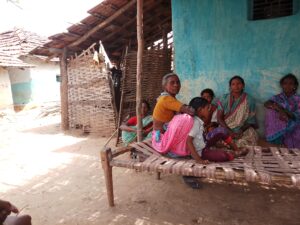
Anand, thirty-something lives in a tiny hut with a tiled roof. He talks, as his wife Vaishali packs a couple of clothes and toiletries into a cloth bag and wraps thick rotis with pickles in a separate small polythene bag. She contributes a word or two every now and then but the family seems tense. Anand and his younger brother are part of a ‘gang’ of labourers recruited by a contractor to work in a factory in Pune, nine hundred kilometres away. The thekedar’s van is expected later that night. Soon Anand’s home fills up with grim-faced villagers; a few of whom are willing to speak.
“I untied the bullocks today, to graze on the stalks,” a man says.
“Feed them as long as you can then sell them cheap in the auction,” grumbles another.
This is the region where agricultural debt and lack of livelihood drives many farmers to migration and some to suicide. They discuss how the distress sale of cattle is affecting them not just economically but psychologically. It is like losing a family member.
Suddenly, a young man moves forward. “What do you want from us? What is the use of writing down all this?” he demands.
“Arey, Pradeep, good you are here,” Viju says with a look of recognition in his eyes. “Madam is a journalist, from Mumbai. She is writing about the sukha dushkaal…”
“I know that,” Pradeep cuts him short, “city people are best at writing and taking pictures. They get money out of it. What do we get?”
I am startled into an unfamiliar guilt. I feel like saying, “Yes, we write and take pictures. We are the vultures that stalk starving children across the world.”
Instead, I ask, “What do you want from me?”
“Your car … lend me your car for an hour.”
I try to hide my discomfort. All eyes in the room turn towards me. His tone challenges me to turn him down but they look surprised when I agree.
We visit a few more homes in this small village. An old woman whom everybody calls Mavshi aunty insists we should eat dinner and serves us hot rice with dal and bitter brinjals cooked in a thin gravy.
“Is it true that these boys are taking your car?” she asks, heaping my plate with another spoonful of spicy dal.
“Hmmm” I answer, but Mavshi doesn’t look convinced.
“Madam, do you think it was the right thing to do?” asks Viju, pouring water into his mouth from a brass glass without letting the glass touch his lips.
“May be not…but find out where they are going.” I decide it would be worthwhile to find out where the car was being taken.
Vehicles enter the village throughout the night. We watch the vans, tractors and SUVs as they roll in; some of which are already packed with people. Women and men scramble in with their ragged bundles to join the others who crouch and huddle, and make place for newcomers muttering curses under their breath. We see Anand and his younger brother hop onto the back of one such van and leave. The heat is unbearable even this late at night. I am glad for the Bisleri bottles.
Viju comes back after making some enquiries. “Madam, they will be going towards their fields,” he says, “and they should be okay with us coming along.”
It is nearly midnight when Pradeep calls us. “We need the gari now,” he says.
“Both of us are coming along,” says Viju, keeping in step with our decision.
“Madam too?” asks Pradeep.
“Yes, I would like to come,” I reply.
“Just don’t write about it,” he says, almost as a request.
Much to the chagrin of the driver, five or six men armed with sabbals – iron rods – get into the car and slam the door shut. Pradeep provides the directions when there is an urgent tap on my window. It is Vaishali, Anand’s wife.
“Mala pan ghya sobat- take me along too,” she says. I realise that I am sitting alone in the middle seat of the SUV with five men at the back and two up-front next to the driver. There is plenty of space for Vaishali and I let her settle in next to me as we set off into moonlit night.
“Did you bring the chavi?” The man in front asks.
“Yes, of course,” comes the reply from the back.
“Chavi is a rod, a crank,” translates Viju for my benefit. Yes, for city people like me, chavi is merely the key used to unlock locks, not a crank.
“How come the chavi is with you?” I ask.
“I am the secretary of the village water distribution committee,” replies the chavi man, in a manner that is matter of fact. “There are only two chavis. One with the engineer saheb and one with me,” he adds.
The bright moonlight lights up the landscape – the tarred road, the tall teak trees, the bamboo undergrowth. We reach a place where a dirt track forks off from the road turning steeply upwards. We stop here and momentarily I regret getting out of the cool air conditioning of the car. The farmers climb up swiftly while I struggle to keep pace with them. I hold on to Vaishali’s arm as she guides me with ease. At a height, the track flattens and turns left. We continue to walk. Then I hear the beautiful soft sound of flowing water. We are walking on the crest of a canal parallel to the road below. On my right, the water glistens and shimmers like a river of mercury. On my left, the dying paddy fields are harshly foregrounded in the yellow moonlight.
“This is Asola Mendha canal madam,” informs Viju as we stop near a sluice gate, “constructed by the British in 1916.”
A few steps ahead Vaishali sinks to her knees. She sits facing the endless acres of miserable paddy. She looks at me and points, “That is our field with the two mango trees at the end. Can you see them? And that plot on the right is our uncle’s. And behind that lies Pradeep’s land – five acres between him and his brother. Do you see the machaan over there? That plot is Jambhule’s, and beyond that lies the plot of the old grandmother, only half an acre…”. As she continues naming the fields, an indescribable sadness fills my heart. She is younger than me but infinitely more tired than I will ever be.
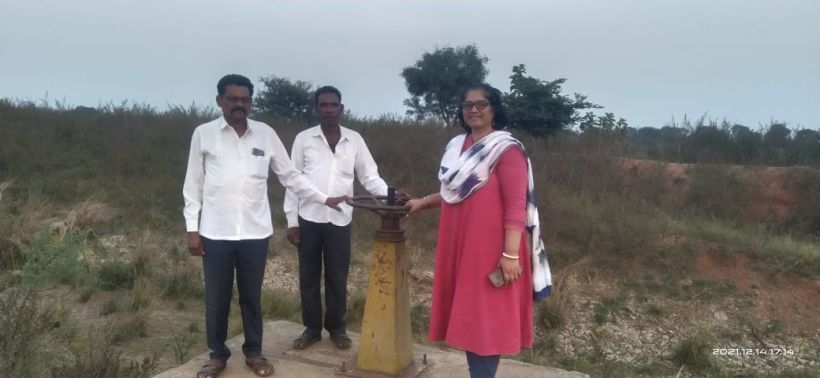
Suddenly, I am aware of the heavy blows of iron bars coming from behind us as the farmers break the chain and locks of the sluice gate. I turn to watch as the silhouetted men insert the crank into the operator and force it to turn. With every turn of the crank, the sluice gates that are underneath us, move up a notch.
“Six…five…four…three…two…one!” the men count the number of chudis or turns of the screw.
Below us the water from the main canal flows into the branch that feeds the paddy – first in a trickle and then in a flow. Water snakes its way through crevices and furrows. Pradeep and his team smash the operator and the screw; they throw the chain and lock in the canal. It will take a long time for the irrigation officials to repair the sluice gate.
I turn to Vaishali. She weeps into the corner of her sari pallu and softly repeats the names of her gods.
“Vaishali,” I reassure her, “Vaishali, the water will reach your fields. I am sure.”
She wipes her tears and dusts her sari to stand up.
We return to the village square wrapped in silence.
“Okay madam … thanks for the car,” says Pradeep, as the men disperse.
Vaishali insists that Viju and I should eat something before we leave or at least drink a cup of tea, but we decline. “Please come back,” she says before stepping back into the shadows.
Viju settles down next to the driver and I put up my aching feet on the back seat.
“Three,” he exclaims as we drive away.
“What?”
“We watered the paddy fields of three villages tonight.”
“We committed a criminal offence tonight. We broke a sluice gate and stole water from a government canal,” I smile to myself and put things in proper perspective for him.
A truck sputters by carrying yet another load of tired, disheartened, thirsty bodies fleeing in search of life.
- Paromita Goswami
(Note: This story was first published by Jaggery Lit Issue 19: Spring 2022 and can be accessed at https://jaggerylit.com/proper-perspective/ . It is based on a true incident that occurred in village Fiskuti of Mul Taluka many years ago.)